Inside a Metal Casting Foundry: Raw Materials to Precision Components
February 7, 2026
Iron Casting Explained: Types, Benefits, and Industrial Uses
March 25, 2026
When manufacturers are selecting materials for heavy-duty components, strength and durability are often at the top of the list. Iron has remained a foundational material in industrial production for generations because of its reliability and performance in demanding environments. But not all casting operations are the same. What sets an iron foundry apart is its ability to combine material knowledge, controlled processes, and quality oversight to consistently produce castings that perform under pressure.
At G&W Foundry, we focus on producing iron castings designed to meet real-world industrial demands. Understanding what makes an iron foundry distinct helps clarify why iron continues to be a trusted material across manufacturing, infrastructure, and heavy equipment applications.
The Role of an Iron Foundry
An iron foundry specializes in melting and casting iron into precise shapes used as structural and mechanical components. While the basic principle of casting has existed for centuries, modern foundries operate with advanced equipment and carefully monitored processes to achieve consistent results.
Iron castings are commonly used in components such as housings, frames, bases, and support structures. These parts must maintain dimensional stability while handling vibration, load stress, and long service life. An iron foundry’s responsibility is not simply to pour metal into molds, but to ensure the finished component meets both performance and dimensional requirements.
Why Iron Remains a Preferred Material
Iron offers a combination of properties that make it especially well-suited for industrial applications.
Strength and Load Capacity
Iron provides excellent compressive strength, allowing cast components to support substantial weight and mechanical stress. This makes it ideal for machinery bases, heavy equipment frames, and infrastructure components where structural stability is essential.
Vibration Dampening
Certain types of iron, particularly gray iron, offer natural vibration-dampening characteristics. This property is valuable in equipment that operates continuously or under dynamic loads. Reduced vibration can help maintain alignment and extend the lifespan of associated components.
Wear Resistance
Iron alloys can be formulated to provide enhanced wear resistance. This is important for parts exposed to friction, abrasive materials, or repetitive movement. Proper material selection within an iron foundry helps ensure components are suited to their intended environments.
The Casting Process Inside an Iron Foundry
Although foundries may vary in layout or equipment, the core steps in producing iron castings follow a structured sequence.
Material Selection and Preparation
Production begins with selecting the appropriate grade of iron based on performance requirements. Factors such as tensile strength, hardness, and machinability influence material choice.
Before melting begins, raw materials are evaluated to confirm they meet required specifications. Maintaining consistent chemistry is critical in an iron foundry because even small variations can affect casting performance.
Melting and Metal Control
Iron is melted in high-temperature furnaces designed for controlled operation. During this stage, the molten metal’s composition and temperature are carefully monitored. Adjustments may be made to maintain the correct balance of elements.
This level of process control helps reduce the likelihood of defects and ensures repeatable results across production runs.
Mold and Pattern Development
Patterns are created to replicate the final component. These patterns form mold cavities that shape the molten iron during pouring. Mold design plays a significant role in casting quality.
Proper gating allows the molten iron to flow evenly into the mold, while venting enables gases to escape. Allowances for shrinkage during cooling are built into the design to maintain dimensional accuracy.
Pouring and Solidification
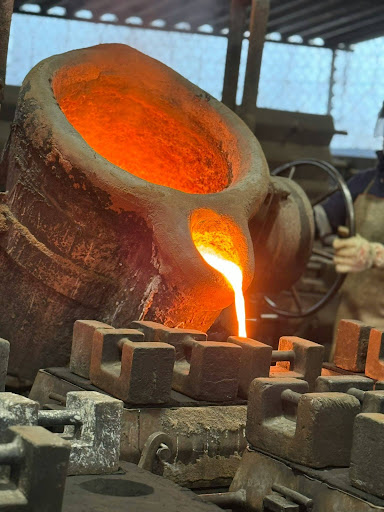
Once the iron reaches the proper temperature, it is poured into prepared molds. As it cools and solidifies, it takes on the shape defined by the mold cavity.
Controlled cooling is essential. Cooling too quickly or unevenly can create internal stresses or distortions. A well-managed iron foundry monitors solidification carefully to protect structural integrity.
Shakeout and Finishing
After solidification, the mold material is removed in a process called shakeout. The raw casting is then cleaned and inspected. Finishing operations may include trimming, grinding, or machining to meet final specifications.
Some castings require minimal finishing, while others undergo additional machining to achieve tighter tolerances. The finishing process ensures the component is ready for integration into larger systems.
Applications Across Industries
Iron castings are used in a wide range of industries due to their strength and adaptability.
Manufacturing Equipment
Machine bases, housings, and frames often rely on iron castings. These components must maintain rigidity under heavy loads and continuous operation. The vibration-dampening qualities of iron are especially valuable in precision equipment.
Infrastructure and Utilities
Iron components are commonly used in infrastructure systems that require long-term reliability. Durability and dimensional stability are critical in these applications, where downtime can be costly.
Heavy Machinery and Industrial Systems
Pumps, gearboxes, compressors, and processing systems frequently incorporate iron castings. These components must withstand mechanical stress, temperature fluctuations, and prolonged use.
An iron foundry supports these industries by producing castings designed to perform consistently over time.
Quality Control and Consistency
What truly sets an iron foundry apart is its commitment to quality control. Casting is not simply about shaping metal; it is about ensuring each component meets defined standards.
Quality measures may include:
- Verification of raw material composition
- In-process inspections during melting and pouring
- Dimensional checks after shakeout
- Surface and structural evaluations before delivery
Identifying potential issues early in production helps reduce waste and supports repeatability across batches.
Consistency is especially important for manufacturers who depend on interchangeable parts or long-term production cycles. Reliable process control allows an iron foundry to maintain uniform performance across multiple runs.
Custom Castings and Engineering Collaboration
Many industrial projects require custom solutions rather than standard parts. Foundries often collaborate with engineers and manufacturers during the design phase to improve manufacturability and long-term performance.
Early involvement allows adjustments in pattern design, gating systems, or material selection that can enhance efficiency and reduce potential production challenges.
This collaborative approach helps ensure that the final casting meets both functional and structural expectations.
The Long-Term Value of Iron Casting
Iron casting continues to play a central role in modern manufacturing because it combines material strength with design flexibility. Complex geometries, internal passages, and reinforced sections can be incorporated into a single casting, reducing the need for extensive fabrication or assembly.
For many applications, casting offers a practical balance between performance and production efficiency. Advances in process control and inspection technology have further improved precision without sacrificing durability.
Choosing the Right Iron Foundry
Selecting the right partner matters as much as selecting the right material. An experienced iron foundry focuses on consistent process control, accurate mold design, and reliable quality oversight.
At G&W Foundry, we combine material expertise with controlled production processes to produce iron castings built for demanding applications. If you’re planning a new project or evaluating casting options, we’re available to discuss your requirements and explore practical solutions.
To learn more about our capabilities or to start a conversation about your casting needs, contact G&W Foundry.