
The Modern Iron Foundry
December 11, 2025
What a Metal Casting Foundry Does: Complete Guide
January 31, 2026
When people think about industrial machinery, they often focus on motors, controls, or moving parts. What tends to get less attention are the structural components that support those systems and allow them to operate reliably over time. Machine castings play that foundational role, providing the strength, stability, and durability required in demanding industrial environments.
At G&W Foundry, we work with manufacturers across a range of industries to produce cast components designed for real-world conditions. Understanding how industrial castings are made and where they’re used helps explain why casting remains such an important manufacturing process today.
What Are Machine Castings?
Machine castings are metal components formed by pouring molten metal into molds that create precise shapes. These castings are commonly used as structural or load-bearing parts in industrial equipment, including frames, housings, bases, and supports.
Unlike decorative or consumer-focused castings, machine castings are designed primarily for performance. They must withstand mechanical stress, vibration, temperature changes, and long service lives without losing dimensional stability. Casting allows these requirements to be met while also supporting complex geometries that would be difficult or costly to achieve through other manufacturing methods.
Why Casting Is Well-Suited for Industrial Components
Casting offers several advantages that make it especially well-suited for industrial applications. One of the most significant benefits is the ability to produce complex shapes in a single operation. Internal cavities, reinforced sections, and thick structural elements can all be incorporated directly into the casting design.
Casting also supports consistency across production runs. Once tooling and process parameters are established, castings can be produced repeatedly with uniform dimensions and material properties. This level of repeatability is critical for manufacturers who rely on interchangeable parts or long-term equipment support.
How Industrial Castings Are Made
Although each foundry may use slightly different methods, the core steps involved in producing industrial castings generally follow a consistent sequence. Careful control at every stage helps ensure the finished casting meets both functional and dimensional requirements.
Pattern and Mold Creation
The process begins with a pattern, which serves as a replica of the final part. Patterns are used to create molds, often made from sand or other materials capable of withstanding high temperatures.
Mold design plays a major role in casting quality. Proper gating ensures molten metal flows evenly into the mold, while venting allows gases to escape safely. Allowances for cooling and shrinkage are also built into the mold design to maintain dimensional accuracy. Decisions made at this stage directly affect the success of the final casting.
Metal Preparation and Melting
Once the mold is prepared, the metal is melted in a furnace. The type of furnace and melting temperature depend on the alloy being used and the performance requirements of the finished part.
During melting, temperature and composition are closely monitored. Removing impurities and maintaining consistent chemistry at this stage helps reduce defects and ensures the metal will perform as expected once it solidifies. Careful metal preparation is essential for producing reliable machine castings.
Pouring and Solidification
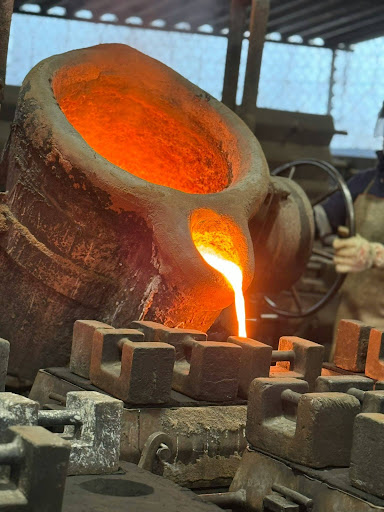
After the metal reaches the proper temperature, it is poured into the mold cavity. As the molten metal fills the mold, it begins to cool and solidify into the shape defined by the pattern.
Cooling time varies based on part size, geometry, and material. Controlled cooling is important to prevent internal stress, cracking, or distortion. Proper solidification helps maintain both structural integrity and dimensional stability.
Shakeout and Finishing
Once the casting has fully solidified, the mold material is removed in a process known as shakeout. The raw casting is then cleaned to remove excess material and surface residue.
Finishing operations may include trimming gates and risers, grinding surfaces, or machining specific features to meet tighter tolerances. These steps prepare the casting for assembly or direct use in industrial equipment.
Materials Commonly Used in Machine Castings
Machine castings are produced using a range of metals selected for their mechanical properties and suitability for specific applications. Common materials include various grades of iron and steel, along with other alloys depending on performance requirements.
Material selection affects strength, wear resistance, vibration dampening, and resistance to environmental factors. For example, some applications prioritize rigidity and load-bearing capacity, while others require stability under thermal stress or continuous operation.
Foundries often work closely with customers to select materials that balance performance needs, cost considerations, and manufacturability.
Where Machine Castings Are Used
Because of their strength and versatility, machine castings are used across many industries and applications.
Manufacturing and Production Equipment
Many machine tools and production systems rely on cast components for frames, bases, and housings. Castings provide the rigidity needed to maintain alignment and precision during operation, which is especially important in high-load or high-vibration environments.
Heavy Machinery and Processing Systems
Pumps, compressors, gearboxes, and industrial processing equipment often incorporate machine castings. These components must support mechanical loads while maintaining consistent performance over long service lives.
Infrastructure and Utility Applications
Machine castings are also used in equipment that supports infrastructure and utility systems. Reliability is critical in these settings, where downtime can disrupt operations or services.
Precision and Quality Control in Casting
Consistency and accuracy are essential when producing machine castings. Modern foundries use quality control measures throughout the casting process to verify dimensions, material properties, and surface quality.
Inspection may occur at multiple stages, from verifying incoming materials to checking finished castings. Early detection of potential issues helps ensure parts meet specifications and perform reliably in the field.
Quality control also supports repeatability, allowing foundries to produce consistent castings across multiple production runs.
Why Casting Remains Relevant in Modern Manufacturing
Despite advances in fabrication and machining technologies, casting continues to be a practical and efficient manufacturing method. Casting allows complex shapes to be formed in a single step, reducing the need for extensive machining or assembly.
This efficiency makes casting especially useful for large or structurally complex components. It also supports scalability, making it suitable for both low-volume custom parts and higher-volume production runs.
Custom Machine Castings and Collaboration
Many industrial projects require custom components rather than standard parts. Foundries often collaborate closely with engineers and manufacturers to develop machine castings tailored to specific equipment designs.
Early involvement in the design process can help improve manufacturability, reduce production challenges, and support long-term performance. For projects requiring specialized solutions, industrial castings can provide additional insight into how custom castings are developed.
Efficiency and Sustainability in Modern Foundries
Modern foundries also focus on improving efficiency and reducing waste. Recycling scrap metal, refining melting practices, and optimizing workflows all contribute to more efficient operations.
These efforts help reduce environmental impact while maintaining the performance and reliability required in industrial castings.
The Role of Machine Castings in Industry
Machine castings provide the structural foundation for countless industrial systems. Their strength, precision, and adaptability make them essential components across manufacturing, infrastructure, and heavy equipment.
By combining proven casting techniques with careful process control and quality oversight, foundries can produce components that meet demanding real-world requirements. At G&W Foundry, we focus on producing machine castings that support reliable performance and long-term use. If you’re evaluating casting options for a current or upcoming project, contact our team to discuss your application and requirements.