
Sand Castings 101: Process, Advantages, and Common Applications
May 5, 2026
Ductile iron has become one of the most dependable cast materials for manufacturers that need strength, stability, and long service life in demanding environments. Foundries that produce ductile iron castings in-house rely on the material for its ability to handle mechanical load, absorb vibration, and maintain dimensional consistency across a wide range of part sizes and shapes.
This expanded guide explores the structure of ductile iron, how grades differ, and how foundries control each stage of production to deliver castings that perform reliably in service.
Why Ductile Iron Remains a Foundry Standard
Ductile iron is a cast iron alloy engineered so that its graphite forms as rounded nodules. This structure gives the material far greater elasticity and impact resistance than grey iron, where graphite appears as flakes. The nodule structure allows ductile iron to behave more like steel while retaining the casting advantages of iron, including fluidity, mold fill capability, and cost-effective production.
Foundries choose ductile iron for components that must withstand shock, vibration, or repeated loading. Its ability to absorb movement and resist fatigue makes it suitable for pump housings, valve bodies, drivetrain components, machinery frames, and municipal infrastructure.
How Ductile Iron Grades Are Defined
Ductile iron grades are identified by mechanical properties rather than strict chemistry. ASTM A536 is the most common specification, listing grades by tensile strength, yield strength, and elongation. These values help engineers match a grade to the demands of the application.
Grades with higher elongation are used where flexibility and impact resistance are priorities. Grades with higher tensile and yield strength support heavier loads or more aggressive service conditions. Foundries achieve these variations by adjusting cooling rates, modifying alloy additions, and applying heat treatments that influence the final matrix structure.
This approach gives foundries the ability to tailor ductile iron to a wide range of performance requirements without changing the overall casting process.
Microstructure: The Foundation of Performance
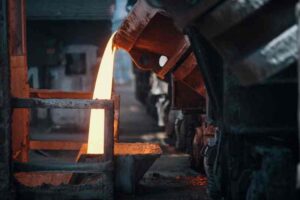
The matrix surrounding the graphite nodules determines how a ductile iron casting behaves once it is placed into service. Foundries control this structure through melting practices, inoculation, and cooling management.
Ferritic matrices provide flexibility, good machinability, and resistance to impact. Pearlitic matrices increase hardness and wear resistance. Heat-treated matrices such as martensitic or austempered structures support applications that require higher strength or improved fatigue performance.
By adjusting cooling rates, alloy content, and heat treatment cycles, a foundry can produce castings that meet specific mechanical targets without altering the overall casting design.
Inside the Foundry: How Ductile Iron Castings Are Made
Although ductile iron has unique characteristics, the casting methods used to produce it are familiar to most metalcasters. Foundries select the process that best matches the geometry, volume, and performance requirements of the part.
Sand Casting
Sand casting remains the most widely used method due to its flexibility and ability to produce both small and very large components. The sand mold provides controlled cooling, which supports consistent nodule formation and stable microstructure.
Shell Molding
Shell molding supports tighter dimensional control and smoother surfaces. It is often chosen for medium-sized components that require consistent wall thickness and repeatable detail.
Lost Foam Casting
Lost foam casting allows intricate internal passages and thin-wall features that are difficult to achieve with other methods. The foam pattern is replaced by molten metal during pouring, producing castings with smooth surfaces and minimal parting lines.
Permanent Mold Casting
Permanent mold casting uses metal molds to produce castings with refined grain structure and consistent density. It is often selected for high-volume production or applications that require repeatable dimensional accuracy.
Centrifugal Casting
Centrifugal casting uses rotation to distribute molten metal against the mold wall. This method produces dense, uniform castings with excellent structural integrity, making it suitable for sleeves, bushings, and cylindrical components.
Regardless of the method, the defining step in ductile iron production is the magnesium treatment that transforms graphite from flakes into nodules. This treatment must be precisely controlled to ensure consistent nodule formation throughout the casting.
Post-Casting Processes That Shape Final Performance
Once a casting solidifies, several finishing steps help refine its mechanical and dimensional characteristics.
Heat Treatment
Heat treatment can relieve internal stress, adjust hardness, or develop specialized microstructures. Foundries use controlled heating and cooling cycles to achieve the desired balance of strength, wear resistance, and machinability.
Machining
Machining ensures that critical surfaces meet tolerance requirements. Ductile iron’s structure supports clean cutting and predictable tool behavior, making it suitable for precision machining.
Surface Protection
Coatings, plating, and other surface treatments protect castings from corrosion or environmental exposure. These treatments extend service life in applications involving moisture, chemicals, or outdoor conditions.
Non-Destructive Testing
Magnetic particle inspection, ultrasonic testing, and radiography verify internal and external integrity. These methods are used for castings that must meet strict performance or safety requirements.
Where Ductile Iron Castings Are Used
Ductile iron supports a wide range of industries because it offers strength, stability, and castability in a single material. Foundries supply castings for automotive systems, heavy equipment, water and wastewater infrastructure, industrial machinery, construction hardware, and energy applications.
Its ability to handle shock, vibration, and mechanical load makes it a dependable choice for both structural and functional components.
Is Ductile Iron Casting Right for You?
If your project requires cast components that can withstand demanding service conditions, our team is ready to help. We work directly with engineers, buyers, and production teams to review drawings, recommend suitable grades, and select the casting method that aligns with your requirements. Whether you need a single prototype or a long-running production program, we support each stage with clear communication and reliable turnaround.
Connect with our foundry today to discuss your part design, request a quote, or begin planning your next ductile iron casting project.
