How to Choose the Right Foundry Company for Your Manufacturing Needs
April 8, 2026
Sand Castings 101: Process, Advantages, and Common Applications
May 5, 2026
When it comes to manufacturing components that must withstand high stress, impact, and long-term use, material selection plays a critical role. Among the many options available, ductile iron casting has become a preferred choice for producing high-strength parts across a wide range of industries.
At G&W Foundry, we work with manufacturers who require reliable, durable components that perform consistently in demanding environments. Ductile iron casting offers a combination of strength, flexibility, and cost efficiency that makes it well-suited for these applications.
Understanding what ductile iron is, how it differs from other materials, and where it’s commonly used can help explain why it remains a key part of modern manufacturing.
What Is Ductile Iron Casting?
Ductile iron casting is a process in which molten iron is treated with alloying elements, typically magnesium, to change the structure of the graphite within the metal. Instead of forming as flakes, as seen in gray iron, the graphite forms into small, rounded nodules.
This structural difference has a significant impact on performance. The nodular graphite allows the material to maintain strength while also improving ductility, or the ability to bend without breaking.
The result is a casting material that offers both strength and flexibility, making it suitable for parts that experience stress, vibration, or impact during use.
A modern ductile iron casting process relies on controlled chemistry, precise mold design, and careful cooling to ensure consistent results.
How Ductile Iron Casting Works
While the general casting process is similar to other forms of iron casting, ductile iron includes additional steps to achieve its unique properties.
Material Preparation
The process begins with selecting the appropriate base iron and preparing it for melting. The composition of the metal must be carefully controlled to achieve the desired strength and performance characteristics.
Melting and Treatment
Once the iron is melted, it is treated with magnesium or other nodularizing elements. This step changes the internal structure of the metal, allowing graphite to form in nodular shapes.
Maintaining the correct temperature and chemical balance during this stage is essential for producing consistent ductile iron castings.
Mold Preparation and Pouring
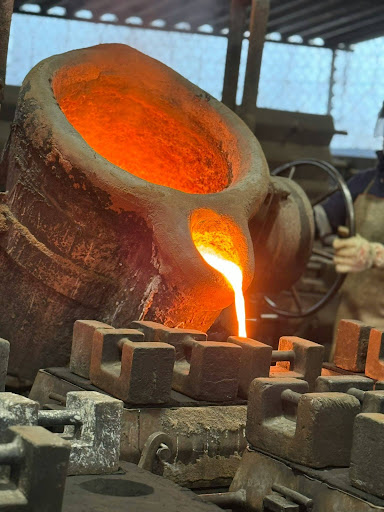
As with other casting methods, molds are prepared using patterns that define the shape of the final component. The treated molten iron is then poured into the mold.
Proper gating and venting ensure the metal flows evenly and fills the mold without defects.
Cooling and Solidification
After pouring, the metal cools and solidifies into the desired shape. Controlled cooling helps maintain the structural integrity of the casting and ensures the nodular graphite structure is preserved.
Finishing and Inspection
Once solidified, the casting is removed from the mold and undergoes finishing processes such as cleaning, grinding, or machining. Quality inspections verify that the casting meets dimensional and mechanical requirements.
Why Ductile Iron Casting Is Preferred for High-Strength Parts
Ductile iron casting offers several advantages that make it particularly well-suited for demanding applications.
High Strength and Durability
One of the primary reasons manufacturers choose ductile iron is its strength. It can handle high loads and mechanical stress without failing, making it ideal for structural components.
Improved Impact Resistance
Unlike more brittle materials, ductile iron can absorb impact without cracking. This makes it suitable for parts that experience sudden forces or vibration during operation.
Flexibility Without Compromising Integrity
Ductile iron provides a balance between rigidity and flexibility. It can bend slightly under stress rather than fracturing, which helps extend the lifespan of components.
Wear Resistance
Many industrial applications involve friction and repeated use. Ductile iron offers good wear resistance, helping components maintain performance over time.
Cost-Effective Alternative to Steel
In many cases, ductile iron casting can provide similar strength to steel while being more cost-effective to produce. This makes it an attractive option for manufacturers looking to balance performance and cost.
Common Applications of Ductile Iron Castings
Because of its strength and versatility, ductile iron is used in a wide range of industries.
Infrastructure and Utility Systems
Ductile iron is commonly used for pipes, fittings, and structural components in water and utility systems. Its durability helps ensure long-term performance in critical infrastructure.
Automotive and Transportation
Many automotive components, including suspension parts, brackets, and housings, are produced using ductile iron casting. These parts must withstand repeated stress and varying loads.
Heavy Equipment and Machinery
Construction and agricultural equipment often rely on ductile iron components for strength and durability. These machines operate in demanding environments where reliable performance is essential.
Industrial Equipment
Pumps, valves, and mechanical systems frequently incorporate ductile iron castings because of their ability to handle pressure and continuous operation.
Quality Control in Ductile Iron Casting
Consistency is critical when producing high-strength components. Foundries implement quality control measures throughout the casting process to ensure reliable results.
These measures may include:
- Chemical composition testing
- Microstructure analysis
- Dimensional inspections
- Mechanical property testing
By maintaining strict quality standards, foundries can produce ductile iron castings that perform reliably in real-world conditions.
How Ductile Iron Compares to Other Casting Materials
Ductile iron offers advantages over several other commonly used materials.
Compared to gray iron, ductile iron provides greater strength and impact resistance due to its nodular graphite structure.
Compared to steel, ductile iron can offer similar strength levels while being easier and more cost-effective to cast. This makes it a practical option for many applications that require durability without the higher cost of steel fabrication.
Understanding these differences helps manufacturers choose the material that best fits their application.
A Reliable Choice for Demanding Applications
Ductile iron casting continues to be a preferred solution for producing high-strength parts because it offers a balance of performance, durability, and efficiency. Its ability to withstand stress, resist wear, and perform consistently over time makes it a valuable material in modern manufacturing.
At G&W Foundry, we focus on producing ductile iron castings that meet the demands of industrial applications through careful process control and material expertise.
If you’re evaluating materials for a project or need a dependable casting partner, contact G&W Foundry to learn more about how ductile iron casting can support your manufacturing needs.